Manufacture of green hydrogen
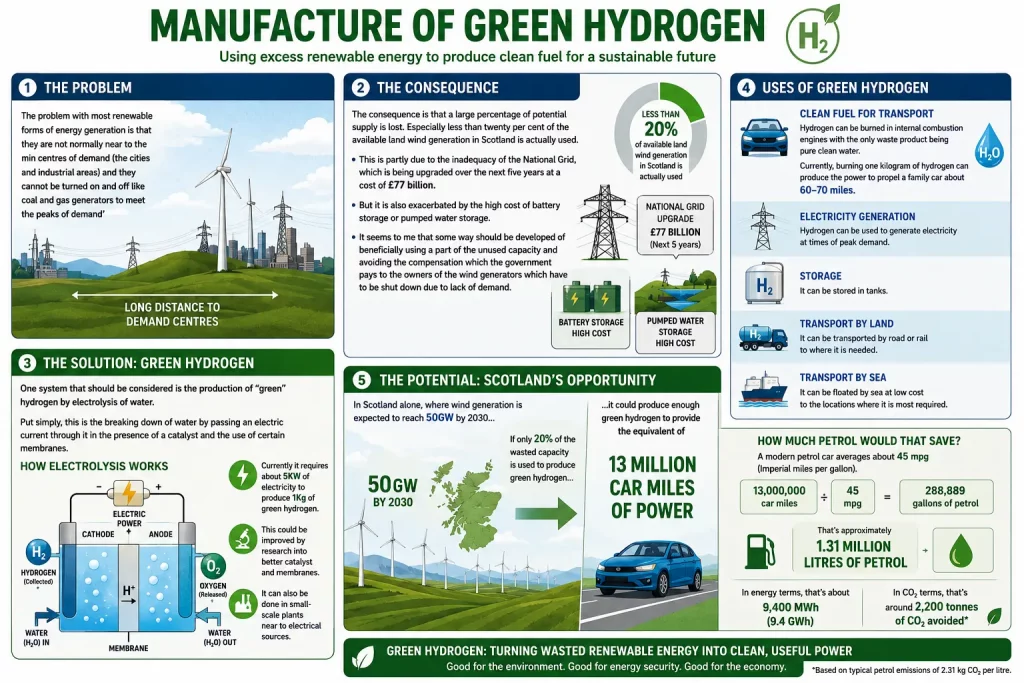
The problem with most renewable forms of energy generation is that they are not normally near to the min centres of demand (the cities and industrial areas) and they cannot be turned on and off like coal and gas generators to meet the peaks of demand’
The consequence is that a large percentage of potential supply is lost. Especially less than twenty per cent of the available land wind generation in Scotland is actually used. This is partly due to the inadequacy of the National Grid, which is being upgraded over the next five years at a cost of £77 billion. But it is also exacerbated by the high cost of battery storage or pumped water storage. It seems to me that some way should be developed of beneficially using a part of the unused capacity and avoiding the compensation which the government pays to the owners of the wind generators which have to be shut down due to lack of demand.
One system that should be considered is the production of “green” hydrogen by electrolysis of water. Put simply, this is the breaking down of water by passing an electric current through it in the presence of a catalyst and the use of certain membranes. Currently it requires about 5KW of electricity to produce 1Kg of green hydrogen, but this could be improved by research into better catalyst and membranes. It can also be done in small-scale plants near to electrical sources.
Hydrogen can be turned in internal combustion engines with the only waste product being pure clean water. Currently, burning one kilogram of hydrogen can produce the power to propel a family car about 60-70 miles. There are of course other uses, such as generating electricity at times of peak demand. It can be stored in tanks and transported by road or rail, or floated by sea at low cost to the locations where it is most required.
One can calculate that in Scotland alone, where wind generation is expected to reach 50GW by 2030, that only twenty per cent of the wasted capacity could produce enough green hydrogen could provide the equivalent of 13 million car miles of power. How much petrol would that save?
If you wish to get in touch with me about any of the matters I raise in my blogs, you can contact me through my website or at mike@mikehillier.co.uk.
Mike.