System potential
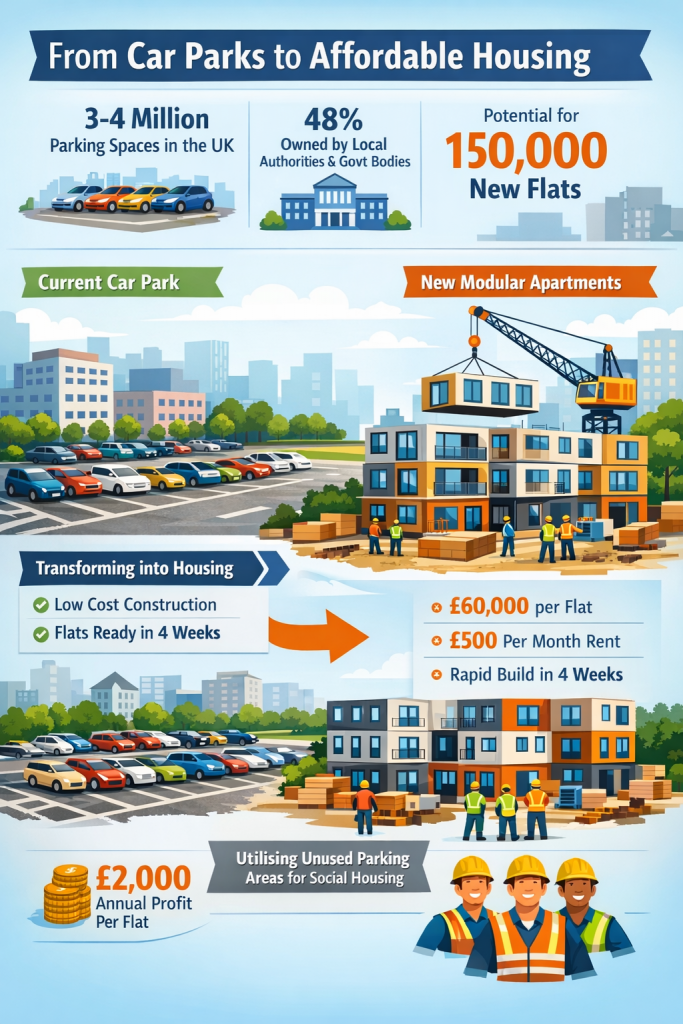
The RAC estimates that there are between three and four million parking spaces in the UK, 92% of them at ground level. It is believed that 48% of these are owned by local authorities and other government bodies, making them suitable for social housing. If only 10% of the spaces were suitable for development using this system, it would suggest a potential 150,000 flats could be built by this method, with official encouragement, in the next five to ten years.
This would give a huge urgently-required boost to this sector.
Without the cost of purchasing the land, I have calculated the cost of complete construction and fitting out of a one-bedroom flat would be about £60,000. If the flats were let at the modest rate of £500/month this should give the local authority a profit of about £2,000 per annum for each flat after paying for loan costs and administration. Similar benefits would be available to universities and hospital trusts for utilising their parking areas.
The flats are constructed much more speedily than by conventional construction. My detailed calculations indicate that a flat can be completed, ready for occupation, in less than four weeks (compared to at least a year for a conventionally constructed house). Total labour time per flat is less than fifty operative days. I estimate the use of semi-skilled, easily-trained labour providing supervised prefabrication and erection work would be about three weeks per flat, adding about 100,000 man/years of employment to the mainly young, previously unemployed workforce.
Why aren’t the authorities willing to test the system?
Next week I will go into detailed costings to prove the system. If you wish to get in touch with me about any of the matters I raise in my blogs, you can contact me through my website or at mike@mikehillier.co.uk.
Mike.